SPACE WEATHER REFERENCE
Kp Index Explained, What Each Number Means for the Northern Lights
One number from 0 to 9, set for every three-hour block, that tells you how far from the pole the aurora can reach.
The Kp index is a 0 to 9 scale of how disturbed Earth's magnetic field is during a three-hour window, and it is the quickest guide to how far south the northern lights can travel. At Kp 5 or higher, NOAA's Space Weather Prediction Center counts the disturbance as a geomagnetic storm.
What Is the Kp Index?
Magnetometers do the measuring. Each observatory converts the largest swing in the horizontal part of the magnetic field over three hours into a local K value, and the planetary Kp is the standardized mean of 13 observatories between 44 and 60 degrees geomagnetic latitude in both hemispheres. NOAA's glossary calls the underlying scale quasi-logarithmic. Each step up stands for a bigger swing than the step below it, and calm sits around Kp 1.For real-time use, NOAA estimates Kp from eight magnetometers spread from Sitka in Alaska and Ottawa in Canada to Hartland in the UK and Canberra in Australia, and its chart refreshes every minute. Values are written in thirds, such as 5-, 5 and 5+, so the scale holds 28 possible values.
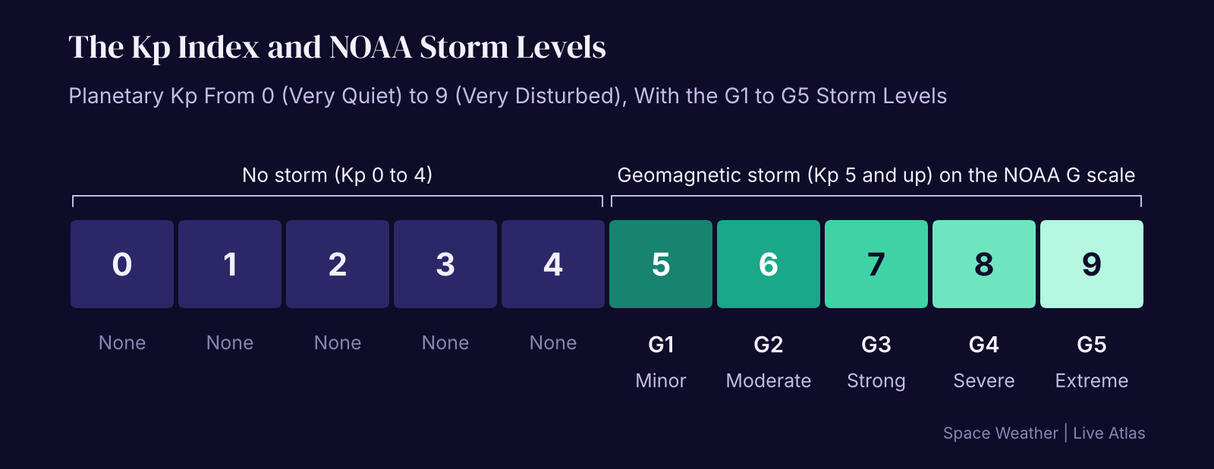
The Kp scale from 0 to 9, with the five NOAA storm levels from G1 to G5.
What Time Does Each Bar on the Kp Chart Cover?
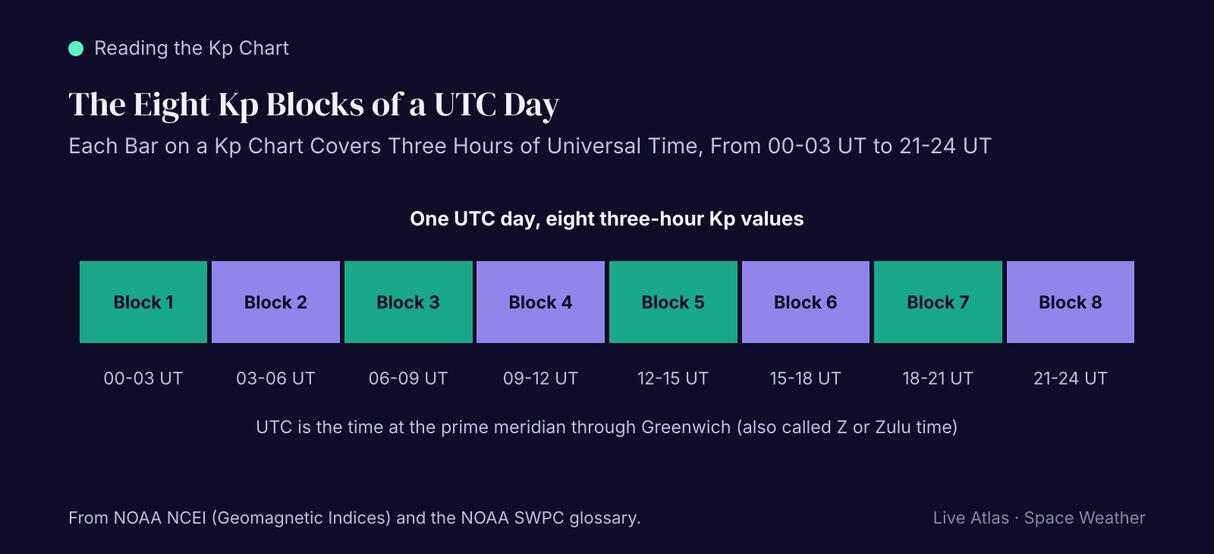
A Kp chart gives one value per three-hour block of Universal Time, eight per day, from 00-03 UT to 21-24 UT (NOAA).
Three hours, counted in Universal Time. NOAA's geophysical data center defines the K index as one digit from 0 to 9 for each 3-hour interval of the universal time day, so a Kp index chart gives every date eight bars, from 00 to 03 UTC through 21 to 24 UTC. A bar's height is the value for its whole block.
Those labels run on a clock that may be far from yours. NOAA's space weather glossary defines Coordinated Universal Time as the local time at the prime meridian, which passes through Greenwich in England. The glossary adds that it was once called Greenwich Mean Time and that military users often say Z or Zulu time. West of Greenwich, local clocks run behind UTC, so in North America the first blocks of a UTC date fall on the evening before. Shift each block by your own offset from UTC, and check that offset again whenever daylight saving time begins or ends.
The bars on NOAA's own chart are estimates. Its Planetary K-index page says the Space Weather Prediction Center derives the estimated 3-hour Kp shown there, and it sends readers to the German Research Centre for Geosciences (GFZ) for the official index. The same estimates set off the center's notices. A K-index warning goes out when an estimated Kp of 4, 5, 6, or 7 or greater is expected, and an alert once the estimate reaches 4 or more.
How Far Does the Aurora Reach at Each Kp?
Higher numbers push the auroral oval toward the equator. NOAA's viewing tips put the oval's equatorward edge near 66 degrees magnetic latitude at Kp 0 and move it about 2 degrees closer to the equator with every step, down to 48 degrees at Kp 9. The table pairs each level with NOAA's storm category and with the places Live Atlas lists as the farthest south the aurora has been seen.
| Kp | NOAA storm level | Aurora seen as far south as |
|---|---|---|
| 0 to 4 | No storm | Mostly Alaska, Canada and other high latitudes |
| 5 | G1, minor | Northern Michigan and Maine |
| 6 | G2, moderate | New York and Idaho |
| 7 | G3, strong | Illinois and Oregon |
| 8 | G4, severe | Alabama and northern California |
| 9 | G5, extreme | Florida and southern Texas |
The right-hand column records past reach rather than a forecast, and NOAA itself describes the link between Kp and auroral latitude as an approximate average. NOAA's 66-to-48-degree figures are magnetic latitudes, so they do not match the lines on a road map.Brightness climbs with the number as well. For Kp 0 to 2 NOAA describes an aurora that stays far north and looks dim and fairly still, while from 3 to 5 it moves away from the poles and becomes brighter and more active. The agency's aurora dashboard sums up the ladder with four labels, from a quiet aurora at Kp 3 through moderate at 5 and active at 7 to very active at 9.
What Do G1 to G5 Mean on NOAA's Storm Scale?
NOAA rates geomagnetic storms from G1 to G5, and every level is tied to a Kp value, so a G number and a Kp number describe the same disturbance. The agency introduced its Space Weather Scales to talk to the general public, with numbered levels in the spirit of the ones used for hurricanes, tornadoes and earthquakes. Two sister scales cover solar radiation storms (S) and radio blackouts (R).
| Level | NOAA name | Kp | Average per 11-year cycle |
|---|---|---|---|
| G1 | Minor | 5 | 1,700, on about 900 days |
| G2 | Moderate | 6 | 600, on about 360 days |
| G3 | Strong | 7 | 200, on about 130 days |
| G4 | Severe | 8, including 9- | 100, on about 60 days |
| G5 | Extreme | 9 | 4, on about 4 days |
The counts fall steeply from one level to the next. NOAA expects a minor storm on roughly 900 days of an average cycle, against about 4 days for the extreme level, so a G1 is routine over a cycle while a G5 is rare. These are long-run averages, and the agency counts one cycle as 11 years.
The aurora follows the same ladder. During a G2 storm NOAA puts its typical equatorward reach at 55 degrees geomagnetic latitude, and the figure drops another 5 degrees with each step, to 40 degrees at G5.
Ground effects climb as well. At G4 the scale warns that some protective systems will mistakenly trip out key parts of the power grid, and at G5 it lists widespread voltage control problems and possible blackouts, with damage to transformers.
What Kp Do You Need to See the Northern Lights?
It depends on where you stand. In the right place, which at low Kp mostly means Alaska and Canada, NOAA's tips say Kp 3 or 4 can bring a very nice display, and NASA says northern states of the continental United States can see auroras at a Kp as low as 4. NOAA places the aurora within view of the country's northern edge at Kp 6 or 7, and directly overhead in the northern states at Kp 8 or 9.The aurora does not have to be overhead. From a hill with an open view to the north, NOAA says you can pick out an aurora that sits up to 1,000 km (600 miles) farther north, low over the horizon. A given Kp therefore means more the closer you live to the oval, and no value guarantees a display on any particular night.
Where Can You Check the Kp Tonight?
Two numbers matter on the night itself, the Kp right now and the highest Kp expected over the next 24 hours. The Live Atlas aurora page shows both next to NOAA's green forecast band, which brightens where an aurora overhead is more likely and is refreshed through the day. Live Atlas is an information site that relays NOAA data, and geomagnetic storm watches and warnings come from NOAA's Space Weather Prediction Center.
Sources
NOAA Space Weather Prediction Center, Planetary K-index
NOAA Space Weather Prediction Center, Tips on Viewing the Aurora
NOAA SWPC Space Weather Glossary and Aurora Dashboard; NOAA NCEI, Geomagnetic Indices
NASA, NASA's Guide to Finding and Photographing Auroras
Live Atlas, Northern Lights Tonight (Kp and NOAA storm level table)
An independent reference on the Kp index and the aurora, based on NOAA Space Weather Prediction Center data. Last reviewed October 2026.